Embodied AI: Desire, AI and Supernormal Stimuli
29. August 2026

Experimental Feedback System
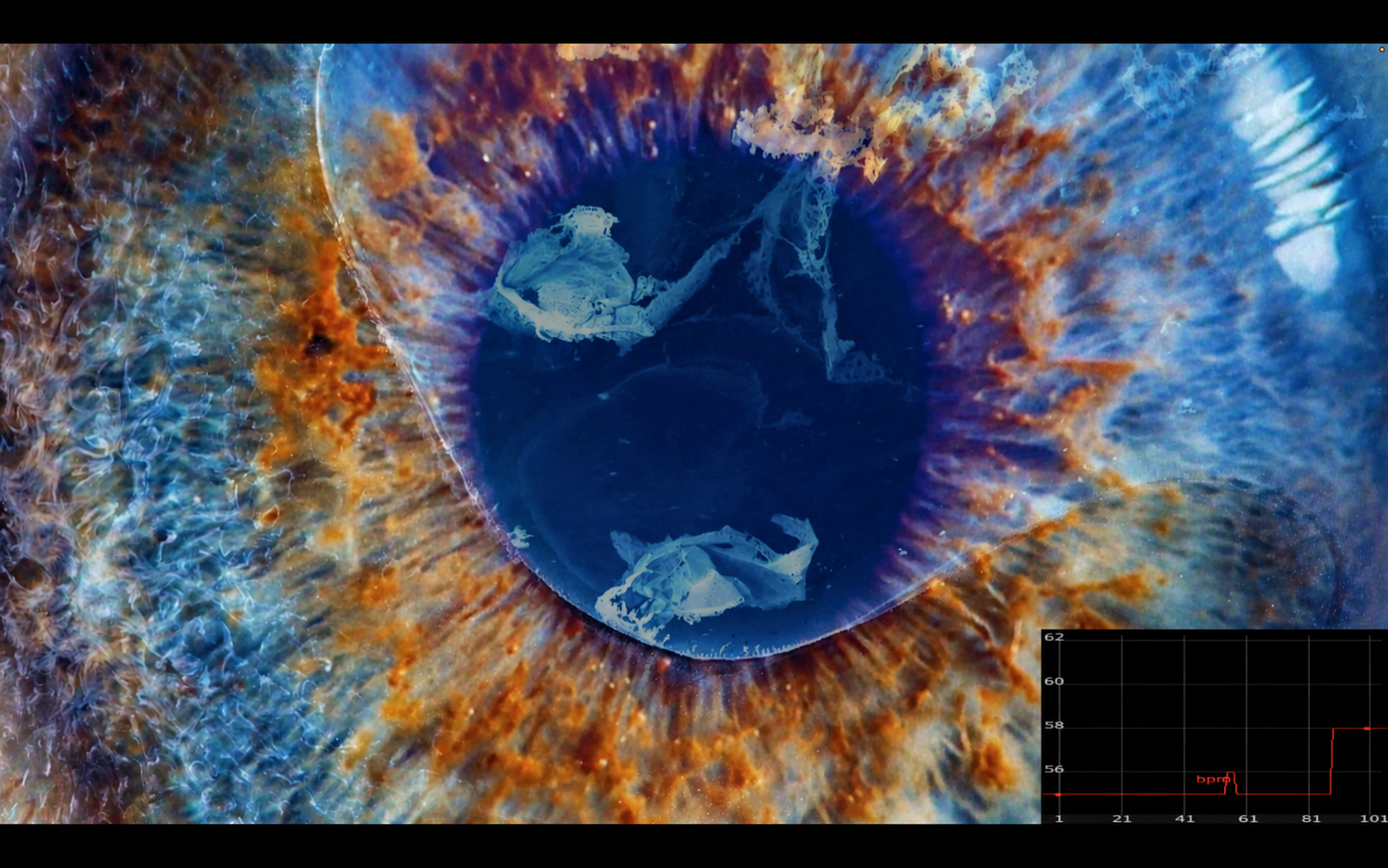
The work establishes a real-time feedback loop between human physiological responsiveness, computational processing, and audiovisual environments. An ECG heart-rate sensor (AD8232) continuously measures the participant’s heartbeat. The signal is transmitted through an Arduino to TouchDesigner, where changes in BPM are processed into three physiological response states. These states dynamically modulate the audiovisual environment rather than functioning simply as measurements of a pre-existing emotional condition.
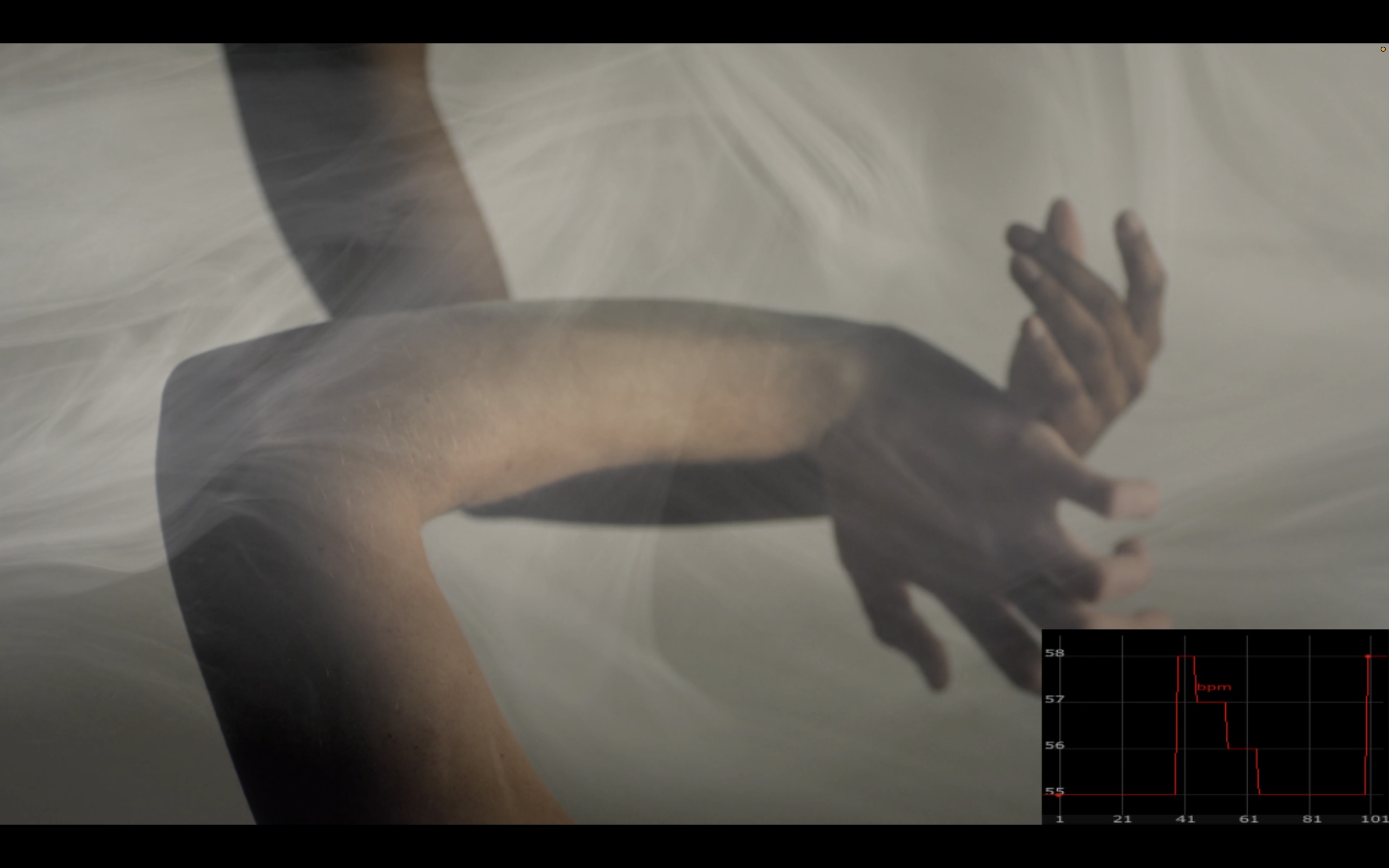
The visual environment consists of 24 pre-produced film sequences organised across eight affective genres. A temporal system continuously moves between these genres, while the participant’s physiological state influences the evolution of the audiovisual environment within each state. The sound environment similarly responds to physiological variation through the continuous mixing of four layers—environment, physiology, material, and intensity—creating gradual rather than discrete transitions.
Operational System_Embodied AI: Desire, AI and Supernormal Stimuli
The resulting system operates as a closed-loop physiological feedback environment:
physiological response → computational modulation → audiovisual stimulus → embodied response → physiological response → …
The participant therefore does not simply control the artwork. Their physiological activity becomes part of an evolving interaction in which the computational environment responds to the body, while the altered environment subsequently becomes a new stimulus for the body.
From Responsive Computation to Generative AI
At selected moments in this interaction, the system captures a visual frame from the currently active audiovisual environment. This frame preserves the particular visual state produced by the ongoing interaction and serves as a reference for a generative-AI process. The next stage of the project integrates this captured material into an image-to-video workflow, enabling generative AI to extend and transform the visual world from which the frame emerged.
The AI therefore does not currently receive physiological data as a direct learning or reward signal. Instead, physiological feedback first conditions the audiovisual state from which a visual frame is captured; generative AI then uses that state as material for producing a new audiovisual sequence. The generated sequence can subsequently re-enter the interactive environment, introducing an additional layer of computational transformation into the existing physiological feedback loop.
This creates a progression from responsive computation to generative computation, and raises the possibility of a further transition toward adaptive human–AI systems.
Embodied Feedback and Human–AI Co-adaptation
The artwork treats the body not simply as a source of data but as an active participant in an evolving human–machine system. Physiological signals are not assumed to transparently represent stable emotional states. Instead, their ambiguity and contextual dependence become part of the experiment: the audiovisual environment influences the participant’s physiological response, while that response in turn alters the computational environment.
This reciprocal structure raises a question directly relevant to human–AI hybrid systems:
What happens when human physiological responses become feedback signals for an adaptive artificial system, while the human simultaneously adapts to the system’s changing behaviour?
The current installation provides a practice-based experimental prototype for investigating this question. Its next research stage is to examine whether embodied physiological and behavioural responses could be incorporated into more adaptive computational architectures, including systems in which human responses function as socially grounded feedback or reward signals.
Rather than claiming that the current installation already implements reinforcement learning, the project proposes a research trajectory from physiological feedback and responsive computation toward adaptive human–AI interaction. This opens questions about whether reciprocal adaptation between humans and artificial agents can produce emergent patterns of attention, affect, desire, and behaviour that cannot be attributed to either participant independently.
From Affect and Cognition to Reciprocal Adaptation
The project builds on my doctoral research into affect, desire, embodiment, and the ways in which affective processes can operate beyond conscious cognitive filtering. It extends this research by asking what changes when affective and physiological responses become computationally actionable within a human–machine system.
The central shift is therefore from studying how affect influences human cognition to investigating how affective feedback may mediate reciprocal adaptation between humans and artificial systems.
In this sense, Embodied AI: Desire, AI & Supernormal Stimuli functions both as an artistic work and as a practice-based experimental prototype for investigating embodied feedback, adaptive machine behaviour, and human–AI co-adaptation.
*This project is a work-in-progress project, partially exhibited at Hybrid Festival 2026 Berlin, and Vorspiel / Transmediale & CTM Festival 2026